Toward a Phenomenology of Sexual Difference by Hein̈amaa Sara
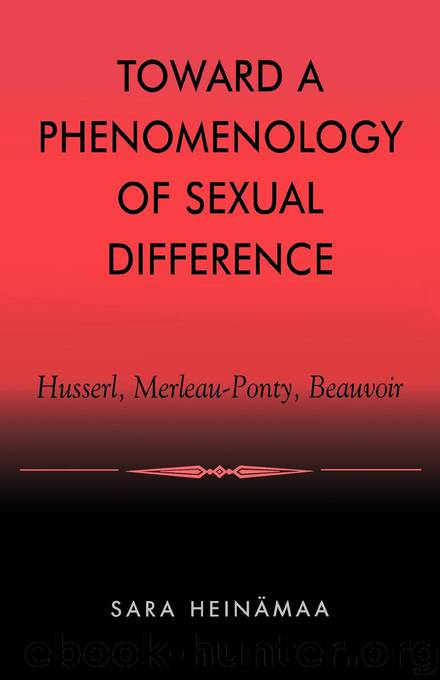
Author:Hein̈amaa, Sara
Language: eng
Format: epub
Publisher: Rowman & Littlefield Publishing Group, Inc.
Published: 2003-03-02T16:00:00+00:00
Notes
1. Husserl’s manuscripts on intersubjectivity contain working notes and fragmentary discussions on drives, reproduction, love, parenthood, and motherhood. Among these is a text titled “Universale Teleologie,” which comprises a sketch for an analysis of sex drive [Geschlechttrieb] (ISIII nr. 34, 593–612). In this text, Husserl’s interest is in studying the relations between procreation [Zeugung], development [Entwicklung], temporality, and sociality. To understand the basis for the temporality of social relations, he focuses his reflection on procreation and the attraction between males and females. Merleau-Ponty refers to this fragment in the working notes of Le visible et l’invisible (VI, 291; E, 238).
2. In her autobiography, Beauvoir also tells about Sartre’s “conversion” to phenomenology. The paragraph is well known and cited in numerous works on Sartre: In 1934, a friend, Raymond Aron, returned from Berlin where he had studied Husserl’s works at the French Institute. Aron told Sartre and Beauvoir about the new ideas he had found in Husserl’s texts. He pointed out that phenomenology does not neglect everyday experiences but makes philosophy out of them. Beauvoir recounts:
We ordered the specialty of the house, apricot cocktails. Aron said, pointing to his glass: “You see, my dear fellow, if you are a phenomenologist, you can talk about this cocktail and make philosophy out of it!” Sartre turned pale with emotion at this. Here was just the thing he had been longing to achieve for years—to describe objects just as he saw and touched them, and extract philosophy from the process. (FA, 157; PL, 135)
Sartre was so impressed that he bought Lévinas’s commentary, Théorie de l’intuition dans la phénoménologie de Husserl (1930), straightaway and read it when walking. He spent the next year studying phenomenology in Berlin (FA, 158, 210–211; PL, 136, 182–183).
3. In the lectures, Husserl studies the conditions of possibility for experiencing temporal objects, such as melodies, for example. He also asks how it is possible to experience oneself as a flow of consciousness; that is, a temporal unity of changing experiences. Finally, he poses the principal question about the temporality of the time-constituting process itself.
Rudolf Bernet, Iso Kern, and Eduard Marbach ([1989] 1995) argue that Husserl changed his view about the temporality of the time-constituting consciousness. In his early writings, until 1908, Husserl placed the time-constituting consciousness in time. In a text written between fall 1908 and summer 1909 there seems to be a change of position (Husserliana X text no. 50). Husserl ends up describing this specific mode of consciousness as non-temporal. Bernet, Kern, and Marbach point out, however, that this does not mean that the time-constituting consciousness is a timeless form. On the contrary, it is in constant change. Yet its “change is not a temporal sequence” (Bernet, Kern, and Marbach [1989] 1995, 109).
4. Beauvoir was also influenced by Lévinas’s phenomenology of caress and his discussion of erotic relations and femininity in Le temps et l’autre. Her comments on Lévinas’s treatment of femininity are strictly critical. It is important to notice, however, that when developing them, she does not step
Download
This site does not store any files on its server. We only index and link to content provided by other sites. Please contact the content providers to delete copyright contents if any and email us, we'll remove relevant links or contents immediately.
4 3 2 1: A Novel by Paul Auster(12559)
The handmaid's tale by Margaret Atwood(7875)
Giovanni's Room by James Baldwin(7487)
Asking the Right Questions: A Guide to Critical Thinking by M. Neil Browne & Stuart M. Keeley(5865)
Big Magic: Creative Living Beyond Fear by Elizabeth Gilbert(5863)
Ego Is the Enemy by Ryan Holiday(5581)
The Body: A Guide for Occupants by Bill Bryson(5229)
On Writing A Memoir of the Craft by Stephen King(5029)
Ken Follett - World without end by Ken Follett(4825)
Adulting by Kelly Williams Brown(4651)
Bluets by Maggie Nelson(4642)
Eat That Frog! by Brian Tracy(4636)
Guilty Pleasures by Laurell K Hamilton(4542)
The Poetry of Pablo Neruda by Pablo Neruda(4202)
Alive: The Story of the Andes Survivors by Piers Paul Read(4118)
Fingerprints of the Gods by Graham Hancock(4086)
The Book of Joy by Dalai Lama(4079)
White Noise - A Novel by Don DeLillo(4063)
The Bookshop by Penelope Fitzgerald(3916)
